Shuttle Bus Rental
| Vehicle class | Shuttle bus |
|---|---|
| Passenger capacity | By assigned vehicle layout |
| Trip use | Convention shuttles, Employee shuttles |
| Seating layout | Request aisle and entry layout |
| Luggage storage | Specify day bags or checked luggage |
| Boarding access | Specify step-free boarding or lift requirements |
| Climate control | Confirm air conditioning on assigned vehicle |
| Onboard restroom | Confirm availability or plan stops |
| Wi-Fi | Request availability for travel dates |
| Charging ports | Specify USB or AC power needs |
| Audio and video | Specify microphone or screen needs |
| Seat belts | Confirm restraint type for the assigned seats |
| Driver service | With driver |
| Pricing | Custom itinerary quote |
| Service area | Orlando and Central Florida |
| Booking basis | Private group charter |
| Availability | Confirmed for requested travel dates |
Free Quote No payment needed now. We confirm price & availability first.
- Licensed & insured partner operators
- Professional, vetted drivers
- Clean, modern vehicles
- 24/7 booking support
Prefer to talk to a person?
Our California team replies fast, day or night.
Shuttle Bus Rental: A Planner’s Handbook for Moving People on a Schedule
A charter takes a group from A to B. A shuttle does something different: it moves a steady stream of people, over and over, on a timetable. That is why a shuttle bus rental is the backbone of so many California events and businesses, from festival park-and-rides and wedding guest loops to daily employee commutes and hotel-to-venue conference service.
Running a shuttle well is a logistics exercise. You need the right number of buses, a realistic loop time, clear stops and a back-up plan for when traffic on the 405 or the Bay Bridge does what it does. This handbook explains how we plan shuttle programs, how to work out your fleet size, and what to check before you hire any operator in California. When you have a rough idea of your event, send us the details and we will build the plan with you.
Section 1: What Our Shuttle Buses Are
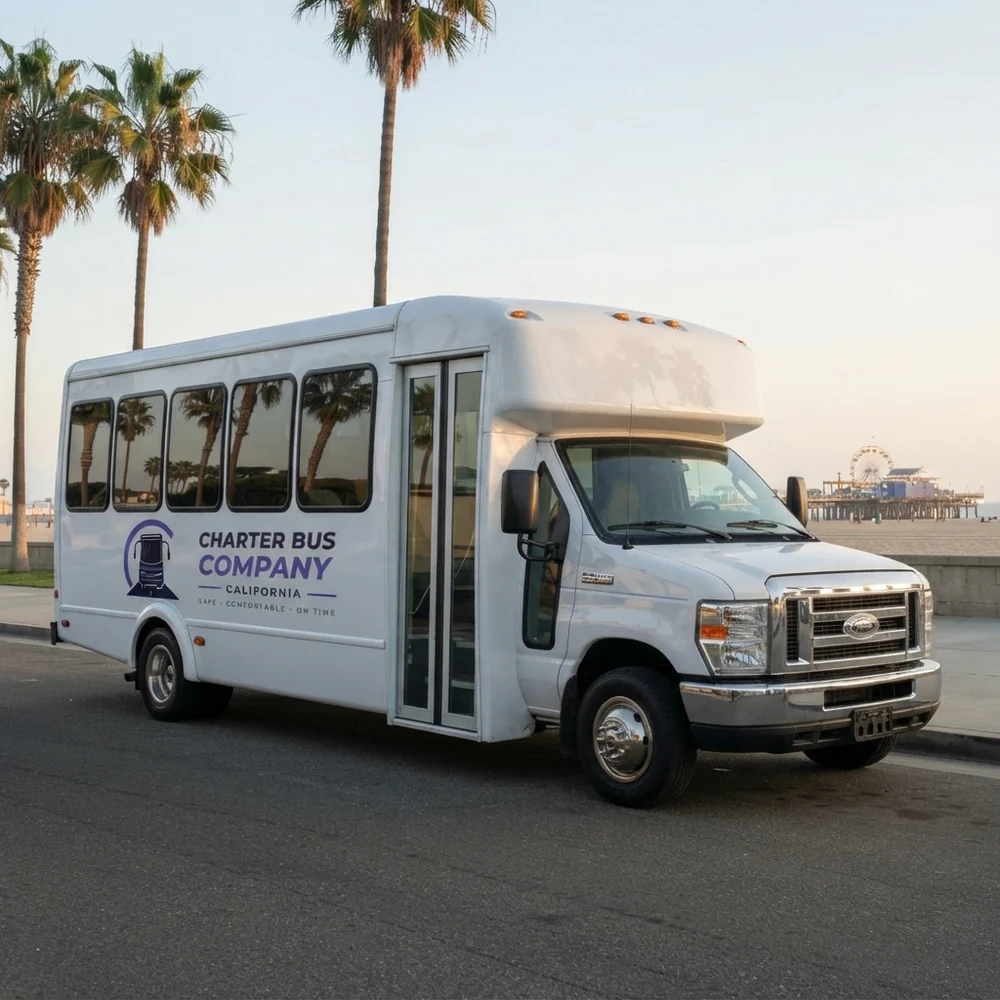
Our shuttle buses are mid-size vehicles, usually built on a heavy-duty chassis, designed for frequent stops and fast boarding. They are typically:
- Seating: around 20 to 40 passengers depending on the model, some with standing room for very short hops
- Entry: wide front doors, low steps and grab rails for quick on-and-off at busy stops
- Luggage: rear racks or storage on airport-configured models
- Comfort: air conditioning and heating, forward-facing seats
- Accessibility: wheelchair lift models available through our wheelchair accessible shuttle bus rental
- Driver: every rental includes a professional, licensed driver
Exact seat counts and features vary by vehicle. We confirm your assigned shuttle in writing. Rates start at [PRICE OR “custom quote”] depending on hours, number of vehicles and date. You can see all shuttle options in our shuttle bus category.
Section 2: The Five Types of Shuttle Programs
Almost every shuttle we run fits one of these five patterns. Knowing which one you need is the first step in planning.
2.1 The continuous loop
Buses circle a fixed route, such as parking lot to festival gate, all day. Riders never need a reservation, they just wait at the stop. Best for festivals, fairs, sporting events, graduations and any venue with remote parking.
2.2 The multi-hotel circuit
Buses connect several hotels to a convention center or venue, often in the morning and evening peaks with lighter service midday. Common for conferences at venues such as the Moscone Center in San Francisco or the Anaheim Convention Center.
2.3 Scheduled point-to-point
Departures at set times between two locations, such as a ceremony and a reception, or a hotel and an airport. Ideal for weddings, gala dinners and group arrivals.
2.4 The employee commute
Weekday service between a transit station, park-and-ride lot or neighborhood hub and a workplace. Used by campuses, hospitals, warehouses and technology companies to cut parking demand and help staff skip the drive. Some companies run these on a long-term contract.
2.5 Airport and terminal shuttles
Group transfers between airports such as LAX or SFO and hotels, ports or venues. These need flight tracking, luggage space and an understanding of each airport’s commercial ground transportation rules.
Section 3: How Many Shuttle Buses Do You Need?
This is the question we are asked most, and it has a straightforward answer once you know three numbers.
- Peak riders per hour. How many people need to travel in your busiest hour?
- Loop time. How long does one complete round trip take, including loading and unloading at each stop?
- Seats per bus. How many people does each shuttle carry?
The formula is:
Buses needed = (Peak riders per hour × Loop time in minutes) ÷ (Seats per bus × 60)
Then round up. Always round up.
Worked example: a vineyard festival
A wine festival expects 2,400 guests. Most arrive between 11 am and 1 pm, so the peak hour sees about 900 riders. The remote parking lot is 3 miles from the gate. One loop takes 14 minutes driving plus 6 minutes loading and unloading, so 20 minutes in total. Each shuttle seats 30.
(900 × 20) ÷ (30 × 60) = 18,000 ÷ 1,800 = 10 buses.
Running ten buses on a 20-minute loop means a shuttle leaves each stop about every two minutes. If budget is tight, the organizer could run seven buses and accept a peak wait of a few minutes more, or stagger entry times on the tickets to flatten the peak.
Rules of thumb we use
- Add 10 to 20 percent to loop time for California traffic at peak hours.
- Plan for the end-of-event surge, which is usually sharper than arrivals because everyone leaves at once.
- Keep one spare vehicle on standby for programs of eight buses or more if budget allows.
- For long single runs, such as 60 people from one hotel, a motorcoach may be cheaper than two shuttles.
Section 4: Headway, or How Long Riders Wait
Headway is the time between buses at a stop. It is the number your guests feel most. Use this table to set expectations.
| Loop time | 2 buses | 4 buses | 6 buses | 10 buses |
|---|---|---|---|---|
| 15 minutes | Every 7.5 min | Every 4 min | Every 2.5 min | Every 1.5 min |
| 20 minutes | Every 10 min | Every 5 min | Every 3.5 min | Every 2 min |
| 30 minutes | Every 15 min | Every 7.5 min | Every 5 min | Every 3 min |
| 45 minutes | Every 22.5 min | Every 11 min | Every 7.5 min | Every 4.5 min |
For most events, a wait of under ten minutes keeps guests happy. For employee shuttles, a reliable timetable matters more than frequency: staff plan around a 7:40 am departure and need it to leave at 7:40.
Section 5: Designing Stops That Work
A shuttle program is only as good as its stops. Poor stop design causes most of the delays we see.
- Get permission. Venues, hotels and cities may require approval for bus loading zones. Some California cities require permits for curbside loading on public streets.
- Separate buses from cars. Rideshare drop-offs and shuttle bays should not share the same curb.
- Make it visible. Branded flags, signs and lighting at night. Guests should spot the stop from the venue exit.
- Staff the stop. At busy events, a staff member at each stop keeps queues orderly and loading fast.
- Plan for shade and weather. Summer heat in the Central Valley, desert and Southern California inland areas is serious. Provide shade and water at long queues.
- Think about accessibility. Keep at least one level, step-free stop location for wheelchair lift boarding.
Section 6: A Second Worked Example, the Employee Commute
Event shuttles are about surges. Employee shuttles are about reliability, day after day. The planning numbers are similar, but the priorities change.
Imagine a company with 180 staff at a business park, 4 miles from the nearest rail station. A staff survey shows about 120 people would ride a shuttle if it met the morning trains. Trains arrive every 15 minutes between 7:00 and 9:00 am, and roughly 30 riders get off each train. The drive from the station to the office takes 12 minutes, so with loading the round trip is about 30 minutes.
Each 30-minute loop can meet two trains. To carry 30 riders from every train without leaving anyone behind, you need one bus at the station for each arrival, so two buses in rotation, each seating at least 30. A third vehicle on standby is optional, but helps cover breakdowns and late trains. The evening program mirrors the morning in reverse.
What makes commute shuttles succeed
- Timed connections. Departures are matched to train or bus arrivals, with a few minutes’ grace for late trains.
- The same drivers. Riders like familiar faces, and regular drivers learn the route quickly.
- Clear communication. A published timetable and a channel for service alerts.
- Regular reviews. Ridership changes with hybrid work schedules. We review numbers with you and resize the fleet when needed.
Section 7: Running the Day
On the day of your event, a shuttle program needs active management, not just buses on the road. This is how we run it.
Dispatch
For larger programs, a dispatcher or onsite supervisor manages the fleet in real time. They watch queue lengths at each stop and move buses to wherever the line is longest. If one stop is empty and another has 200 people waiting, buses are redirected.
Communication
Drivers, dispatch and your event staff agree a communication plan before the day, by phone or radio. Everyone knows who to call if a stop overflows, a guest needs help, or a road closes.
Driver briefings
Every driver receives a route map, stop list, the schedule, onsite contacts and any venue rules, such as where buses can idle and where they cannot.
Last bus protocol
We agree a “last bus” time and announce it clearly, then sweep every stop before closing service so nobody is left behind.
Section 8: What to Tell Your Riders
Good rider communication cuts confusion and keeps queues moving. Share these details on your event website, tickets, invitations or staff email:
- Stop locations, with a map and a short description such as “Lot C, next to the main entrance”
- Service hours, including the first and last departure
- How often buses run during peak and off-peak periods
- Accessibility details, including how to request a lift-equipped bus
- What riders can bring, such as coolers, chairs or luggage
- A phone number or text line for questions on the day
Section 9: Common Shuttle Problems and How We Prevent Them
| Problem | Usual cause | How we prevent it |
|---|---|---|
| Long lines at the end of the event | Fleet sized for arrivals, not departures | Plan for the exit surge and stagger closing times where possible |
| Buses bunching together | No active dispatch | A supervisor spaces buses evenly on the loop |
| Guests at the wrong stop | Poor signage or unclear instructions | Visible branded signs and stop staff |
| Buses stuck in car traffic | Shared lanes with guest parking | Dedicated bus entrance or lane agreed with the venue |
| Driver over hours | Long events with one shift | Planned driver changeovers within legal limits |
Section 10: Shuttle Programs Across California
California is big, and every region brings its own transport challenges. Here are some of the shuttle programs we plan most often.
Festivals and concerts
Desert music festivals, county fairs, food and wine events and stadium concerts all rely on shuttles from remote parking or hotel clusters. These programs need careful surge planning and coordination with event security.
Wine country weddings and tastings
Napa, Sonoma, Paso Robles, Temecula and Santa Ynez Valley vineyards often sit on narrow, winding roads with limited parking. A shuttle collects guests from town hotels and returns them safely after the celebration. For smaller groups, see our Sprinter van rental.
Conferences and trade shows
San Francisco, San Jose, Los Angeles, Anaheim and San Diego host major conventions every year. Multi-hotel circuits keep attendees moving without everyone needing a rideshare at 8 am.
Corporate campuses
Employee shuttles connect workplaces to Caltrain, BART, Metrolink and light rail stations, or to park-and-ride lots. These programs can help companies reduce parking demand and support commuter benefits.
Universities and schools
Orientation weeks, graduation ceremonies and game days all need temporary shuttle service. For longer school trips, see our school bus rental.
Film, TV and production
Production crews need base camp to set shuttles, often early in the morning and at short notice. We plan these runs around call times.
Hospitals and care facilities
Staff parking shuttles and patient visitor shuttles need dependable, accessible vehicles. Ask about our accessible models.
Section 11: Planning a Wedding Shuttle
Weddings are the most personal shuttle programs we run, and they have a rhythm of their own. Guests are dressed up, often unfamiliar with the area, and expecting the day to run like clockwork. A simple plan looks like this:
- Count guests by hotel. If most guests stay at two or three hotels, a shuttle can serve all of them. Scattered guests may need a central meeting point.
- Work back from the ceremony time. Guests should arrive 20 to 30 minutes before the ceremony starts. Count back from there, adding loading time at each hotel and a traffic buffer.
- Decide on return runs. Not every guest wants to leave at the same time. Two or three return departures, such as an early run for families and a last run after the final dance, keep everyone happy.
- Share the schedule. Put the shuttle times on your wedding website and in welcome bags at each hotel.
- Name a point person. A planner, coordinator or trusted friend who can talk to the driver so the couple does not have to.
For couples who want something with more character, a charter trolley or a limo Sprinter for the wedding party can run alongside the guest shuttle.
Section 12: Licensing and Safety in California
California has its own rules for companies that carry passengers for hire, on top of federal regulations. Checking them takes five minutes and protects your guests and your organization.
California Public Utilities Commission (CPUC)
Charter-party carriers operating in California generally need a permit or certificate from the CPUC, shown as a TCP number. The CPUC explains the requirements on its charter-party carriers page. Our TCP number is [TCP NUMBER].
California Highway Patrol (CHP)
The California Highway Patrol carries out safety inspections of passenger carriers and enforces commercial vehicle rules on California roads.
Federal registration
Carriers that operate across state lines must also be registered with the Federal Motor Carrier Safety Administration. Look up any carrier on FMCSA SAFER, and read the FMCSA’s Look Before You Book guide. Our USDOT number is [USDOT NUMBER].
Insurance
Ask for a certificate of insurance, and if your venue requires it, ask for your organization to be named as an additional insured. [STATE YOUR INSURANCE COVERAGE OR “Certificates of insurance are available on request.”]
Read more on our safety commitment page.
Section 13: Accessibility
Public-facing shuttle services should be usable by everyone. Wheelchair users need vehicles with a lift or ramp and securement positions, and stops need step-free access. If your program is open to the public, talk to us about the right mix of accessible vehicles. The ADA.gov site has guidance on transportation and accessibility. Learn more about our accessible shuttle options.
Section 14: Your Shuttle Program Timeline
| When | What to do |
|---|---|
| 3 to 6 months out | Estimate attendance and peak hour, choose stop locations, request a quote, reserve vehicles |
| 6 to 8 weeks out | Confirm permits for loading zones, finalize route maps, agree signage |
| 3 to 4 weeks out | Publish shuttle times on your event website and tickets, brief stop staff |
| 1 week out | Final run of show with our dispatch team, confirm onsite contacts and radio or phone plan |
| Event day | Drivers on site before first departure, dispatch monitors traffic using sources such as Caltrans QuickMap and adjusts the fleet as needed |
| After the event | Debrief on rider numbers and wait times to improve next year’s plan |
Section 15: What Your Shuttle Quote Is Based On
- Number of buses. The biggest driver of cost.
- Hours of service. Including the driver’s travel time to and from the first stop, and any minimum hours. [ADD YOUR MINIMUM HOURS.]
- Date and demand. Festival weekends and graduation season are busy.
- Vehicle type. Accessible, airport-configured and newer models may cost more.
- Long-term contracts. Employee shuttles on a weekly or monthly schedule are quoted differently from one-day events.
- Fees. Parking, permits and airport access fees where they apply. [STATE GRATUITY POLICY.]
Shuttle Bus vs. Other Vehicles
Shuttles are built for frequent stops. For other trip types, compare:
- Minibus rentals for a single group making a few stops.
- 56-passenger charter bus for long runs and large groups.
- Executive coach rental for VIP and corporate travel.
- Charter trolley rental for a fun, open-feel shuttle at weddings and downtown events.
- 14-passenger transit van for smaller runs.
Shuttle Bus Rental FAQ
How many people does a shuttle bus hold?
Our shuttle buses usually seat about 20 to 40 people, depending on the model. Your quote confirms the exact capacity.
Do I need a reservation system for riders?
For continuous loops, no. Riders simply wait at the stop. For scheduled departures with limited seats, such as airport transfers, a simple sign-up list helps.
Can you run shuttles for multi-day events?
Yes. We plan daily schedules, driver shifts and overnight vehicle parking for events running several days.
Do you offer long-term employee shuttle contracts?
[CONFIRM. E.G. “Yes. We offer weekly and monthly contracts for corporate, campus and hospital shuttles.”]
Can shuttles pick up at LAX, SFO or San Diego airport?
Yes, subject to each airport’s commercial ground transportation rules. We plan pickup locations and any access fees in advance.
What happens if traffic delays the loop?
Our dispatch team monitors the route and can re-sequence buses, shorten the loop or add a standby vehicle where one is booked.
Are your shuttles licensed in California?
Yes. Our CPUC TCP number is [TCP NUMBER] and our USDOT number is [USDOT NUMBER].
How far in advance should we book a shuttle program?
For large events needing many buses, three to six months is ideal. Graduation season, festival weekends and big convention dates fill quickly. Smaller programs can often be arranged with a few weeks’ notice.
Can drivers help with luggage and mobility needs?
Drivers can assist with boarding and loading luggage on airport runs. For passengers who use wheelchairs, book a lift-equipped shuttle so they can ride safely.
Can we brand the shuttles for our event?
[STATE YOUR POLICY ON SIGNAGE OR VEHICLE BRANDING.] Branded stop signs are always a good idea.
What if we need to cancel or reduce the number of buses?
See our refund and cancellation policy for deadlines and fees, and read our terms and conditions.
Plan Your Shuttle Program
Send us your expected attendance, peak times and stop locations, and we will calculate the fleet size, loop time and headway, then send a written proposal. Request a shuttle quote, call [PHONE NUMBER], or contact our team. Browse the rest of our vehicles or learn more about us.
Reviews
There are no reviews yet.