
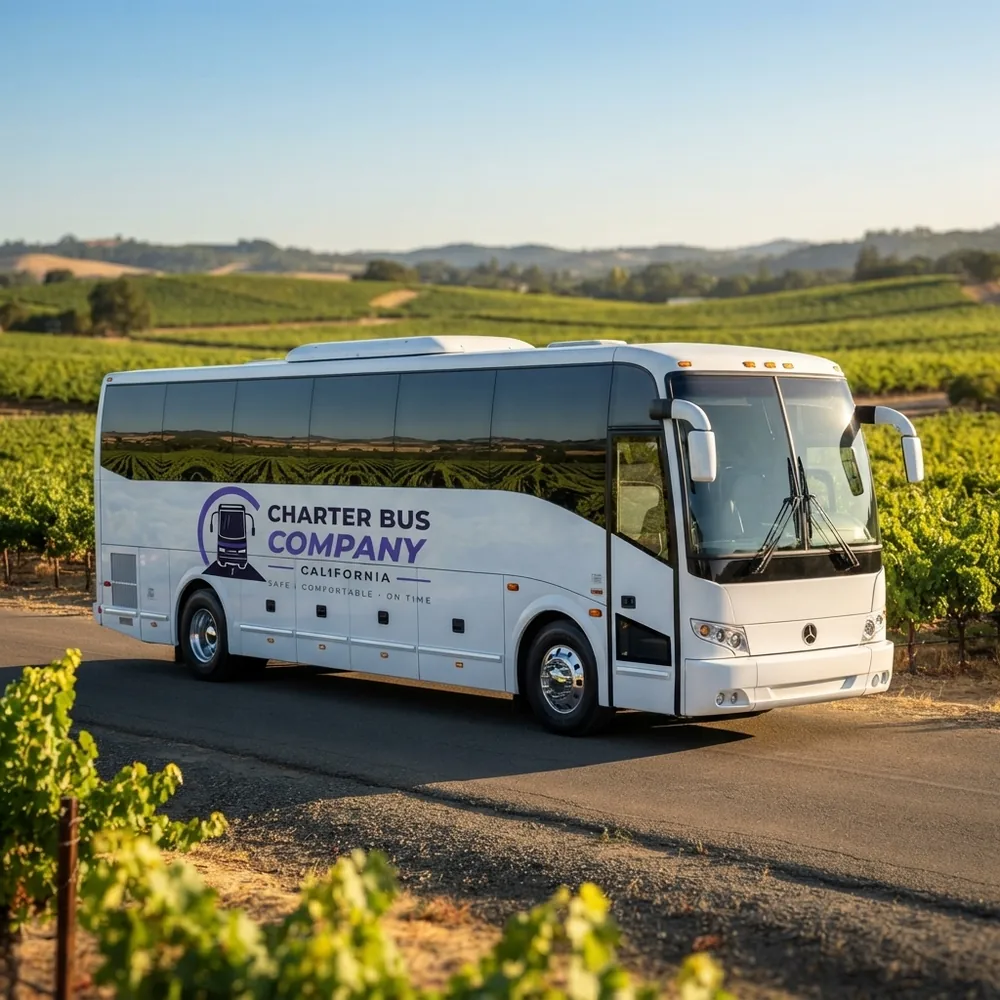
Executive Coach Rental
| Vehicle class | Executive coach |
|---|---|
| Passenger capacity | By assigned vehicle layout |
| Trip use | Business travel, Site visits |
| Seating layout | Request executive seating plan |
| Luggage storage | Check separate space for presentation materials |
| Boarding access | Specify step-free boarding or lift requirements |
| Climate control | Confirm air conditioning on assigned vehicle |
| Onboard restroom | Request equipped coach |
| Wi-Fi | Request availability for travel dates |
| Charging ports | Specify USB or AC power needs |
| Audio and video | Specify microphone or screen needs |
| Seat belts | Confirm restraint type for the assigned seats |
| Driver service | With driver |
| Pricing | Private charter quote by itinerary |
| Service area | Orlando and Central Florida |
| Booking basis | Private group charter |
| Availability | Confirmed for requested travel dates |
Free Quote No payment needed now. We confirm price & availability first.
- Licensed & insured partner operators
- Professional, vetted drivers
- Clean, modern vehicles
- 24/7 booking support
Prefer to talk to a person?
Our California team replies fast, day or night.
Executive Coach Rental: Corporate Ground Transportation, Done Properly
When the people on board are your leadership team, your investors, your top clients or a visiting delegation, the vehicle is part of the message. An executive coach rental gives you a private, quiet, professionally driven space where your group can work, meet and recover between appointments, instead of losing hours to traffic in separate cars.
This page is written for the people who book corporate transport: executive assistants, event and travel managers, procurement teams and founders. It explains what makes a coach “executive”, where it fits in your travel program, how to vet any operator, and what a day on board actually looks like.
The Brief in 60 Seconds
- What it is: a coach fitted with fewer, larger seats and business-friendly features such as lounge seating, tables, power and connectivity.
- Who it is for: corporate groups of roughly 10 to 40 people who need comfort, privacy and the ability to work on the move.
- Typical uses: investor and sales roadshows, leadership offsites, client hospitality, site visits, recruiting tours, conference VIP transfers and delegations.
- What is included: a professional driver, fuel and the vehicle. Parking, tolls and driver accommodation are itemized.
- Price: [PRICE OR “custom quote based on hours, distance and vehicle”].
- Compliance: CPUC TCP [TCP NUMBER], USDOT [USDOT NUMBER], insurance certificate on request.
What Makes a Coach “Executive”?
There is no single industry definition, which is why it pays to ask exactly what you are getting. When we describe a vehicle as an executive coach, we mean it has most or all of the following. Features vary by vehicle, so we confirm the specification of your coach in writing.
- Reduced seating
- Fewer seats than a standard coach of the same size, so every passenger gets more space. A coach that might carry 56 tourists may be configured for far fewer executive passengers.
- Lounge and conference areas
- Club-style seating around tables, wraparound sofas or facing seats, so a team can talk, review documents or hold a meeting while traveling.
- Premium seats
- Leather or high-grade upholstered seats with generous recline and legroom.
- Power and connectivity
- Outlets or USB at every seat and onboard Wi-Fi. Wi-Fi is usually cellular-based, so speed depends on coverage along the route.
- Screens and audio
- Monitors and sound systems for presentations, video calls or briefings.
- Refreshment area
- A galley or refreshment station with a refrigerator on many models.
- Onboard restroom
- Standard on larger executive coaches, which makes long site visits and regional trips practical.
- Privacy
- Tinted windows, a quiet cabin and a driver who understands discretion.
Executive Coach vs. Other Corporate Options
| Option | Typical group size | Workspace | Restroom | Best for |
|---|---|---|---|---|
| Executive Sprinter | Up to about 14 | Limited, captain’s chairs | No | Small leadership teams, airport VIP transfers |
| Executive minicoach | Mid-size groups | Good | Model dependent | Department offsites, client groups |
| 32-passenger executive minibus | Up to 32 | Good | Model dependent | Conference delegations, recruiting tours |
| Executive coach (this page) | About 10 to 40 | Excellent, lounge and tables | Usually yes | Roadshows, retreats, long site visits, VIP hospitality |
| Standard motorcoach | 50 to 60 | Basic | Usually yes | Large staff events, all-hands transport |
If your group is mostly about moving numbers, such as 300 employees to a company picnic, a fleet of standard coaches or a shuttle bus program is better value. Choose an executive coach when the time on board matters as much as the destination.
Signs You Need an Executive Coach, Not a Standard Bus
Not every corporate trip needs an executive interior. These are the situations where the upgrade usually pays for itself:
- The people on board bill hundreds of dollars an hour, and the drive time is a chance to work rather than wait.
- You are hosting clients, investors or partners, and the trip is part of the relationship.
- The day involves more than two hours on the road, so comfort, a restroom and workspace really matter.
- The group needs to talk privately as a team, which is hard in rows of forward-facing seats.
- The trip spans several stops where a standard coach would feel too impersonal and several cars would be too fragmented.
If none of these apply, a standard 47-passenger charter bus or a minibus is likely the more economical choice, and we will tell you so.
Where California Companies Use Executive Coaches
Investor and sales roadshows
Back-to-back meetings across San Francisco, the Peninsula and San Jose, or between Century City, Santa Monica and Irvine, are hard to run on time with rideshares. An executive coach waits outside every building, the team preps between meetings, and nobody hunts for parking. For very small roadshow teams, a 10-passenger executive Sprinter may be enough.
Leadership offsites and board retreats
Monterey, Carmel, Big Sur, Napa, Sonoma, Santa Barbara, Ojai, Palm Desert and Lake Tahoe are popular retreat destinations. A coach collects the team from the office or airport, and the drive becomes the opening session: agenda review, a strategy discussion, or simply time for the team to reconnect.
Site visits and facility tours
Manufacturing plants in the Inland Empire, agricultural operations in the Central Valley, logistics hubs near the Ports of Los Angeles and Long Beach, energy projects in the desert. Site visits often mean long drives between locations. An executive coach with a restroom and workspace makes a full day of visits realistic.
Client hospitality
Golf days, wine country tastings, sporting events and concerts with your most important clients. The coach sets the tone from the moment guests board.
Conferences and trade shows
For VIP speakers, executives and key accounts at events at the Moscone Center, the Anaheim Convention Center or San Diego’s waterfront venues, a dedicated executive coach runs private transfers while general attendees use shuttles.
Entertainment, media and production
Talent transport, press junkets, location scouts and premiere nights all need discretion, flexibility and comfort. For crews needing a place to rest between long shoots, also see our entertainer sleeper coach rental.
Delegations and government visits
International trade delegations, university partnerships and public-sector visits need reliable transport that reflects well on the host. We plan routes, timings and security needs with your team.
Recruiting and campus tours
Bringing candidates or interns to see offices across the Bay Area or Southern California? A branded welcome on an executive coach makes a lasting impression.
A Day on Board: Bay Area to Monterey Leadership Offsite
To show how this works in practice, here is an illustrative schedule for a 22-person leadership team traveling from a San Francisco office to a two-day retreat on the Monterey Peninsula.
| Time | What happens |
|---|---|
| 7:30 am | Coach arrives at the office. Driver confirms route and timings with the onsite contact. |
| 8:00 am | Departure. Coffee and breakfast served from the refreshment area (catering arranged by your team or caterer). |
| 8:15 to 9:30 am | CEO opens the offsite using the coach’s PA and screens. Agenda and goals for the two days. |
| 9:30 to 10:15 am | Breakout discussions in the lounge and table areas while the coach heads south. |
| 10:30 am | Arrival at the resort. Luggage unloaded from the under-floor bays. |
| Day 1 evening | Coach takes the team to a group dinner in Carmel and returns them to the resort. |
| Day 2, 3:00 pm | Departure for San Francisco, with an optional stop at SFO for team members flying out. |
| Day 2, 5:30 pm | Office drop-off, depending on traffic. |
On a two-day trip like this, the driver’s overnight accommodation is included in the quote, and the schedule is planned within federal and state driver hours limits.
Planning a Multi-Stop Roadshow: A Working Method
Roadshows are the most demanding executive trips we run. Meetings are short, buildings are spread out and timings are rarely in your control. This is the method we use with executive assistants to keep the day on track.
- Start with the fixed points. List every meeting with its start time, end time and full address, including the building entrance and any security check-in instructions.
- Map realistic drive times. We check drive times for the actual time of day, not the middle of the night. A 12-mile hop across Los Angeles at 4:30 pm is a very different trip from the same hop at 11 am.
- Add a buffer between every meeting. We recommend at least 15 minutes, and more where meetings tend to overrun.
- Plan the curb. Many office towers have loading zones or porte-cochères with time limits. We confirm where the coach can stop, and where it can wait between meetings.
- Build in a working lunch. Lunch on the coach between meetings can save an hour. Arrange catering for collection or delivery to the coach.
- Share one master itinerary. The EA, the driver, our dispatch team and the lead traveler all work from the same document.
- Agree a change protocol. If a meeting moves, who tells the driver? Usually it is the EA or the lead traveler, by text or phone.
Premium Coach Models
Executive interiors are fitted to high-quality motorcoach platforms. If your organization has a preference for a particular make, or you want to see what the base vehicles look like, browse our premium coach models. Availability of executive configurations varies, so ask us which vehicles can be fitted for your trip.
- Prevost H3-45 motorcoach
- Van Hool CX45 motorcoach
- Van Hool C2045 motorcoach
- Setra S 417 TC motorcoach
- Setra S 407 motorcoach
- Mercedes-Benz Tourrider Premium motorcoach
Notes for Executive Assistants and Travel Managers
You are usually the person who makes the trip work, often while handling a dozen other tasks. These small steps save you time and protect your travelers’ day.
- Send a passenger list. Names and mobile numbers for the lead traveler and at least one backup contact.
- Flag VIP preferences. Preferred seating, dietary needs for any catering, temperature preferences, accessibility needs.
- Confirm luggage. On airport days, roller bags and garment bags are easy. Large exhibition materials or sample cases need to be mentioned.
- Ask for the driver’s name and number. We share these before the trip so your travelers know who to look for.
- Plan for the end of the day. If some travelers head to the airport and others to a hotel, tell us so the route is planned in the right order.
- Keep our dispatch number handy. [PHONE NUMBER] reaches our team throughout your trip.
Accessibility for Executive Groups
Leadership teams and delegations include people with a range of mobility needs. If any traveler uses a wheelchair or has difficulty with steps, let us know when you book. We can advise on vehicles with a lift, such as our wheelchair accessible motorcoach, or run an accessible vehicle alongside the executive coach so the whole group travels on the same schedule. The ADA.gov site has more on transportation accessibility.
Duty of Care: The Procurement Checklist
Your organization has a duty of care to the people it transports. Before you sign any agreement for executive ground transportation, check the following. We are happy to provide every item on this list.
| Check | What to ask for | Why it matters |
|---|---|---|
| State authority | CPUC TCP number for California charter operations | Charter-party carriers in California generally need CPUC authority. See the CPUC charter-party carrier page. |
| Federal authority | USDOT number and operating status | Verify it on FMCSA SAFER, especially for trips across state lines. |
| Insurance | Certificate of insurance, with your organization named as additional insured if required | Protects your company and passengers. |
| Driver qualification | Commercial licensing, background checks, drug and alcohol testing, training | The driver is the single biggest factor in safety. |
| Driver hours | How long days and overnight trips are staffed | Federal rules limit driving and on-duty time. See the FMCSA hours of service summary. |
| Vehicle maintenance | Inspection and maintenance practices, and vehicle age | Reduces the risk of breakdowns on the day. |
| Contingency plan | What happens if a vehicle fails or a driver is unwell | Executive schedules cannot absorb long delays. |
| Contract terms | Cancellation, changes and payment terms | Read our terms and conditions and cancellation policy. |
The FMCSA’s Look Before You Book page is also a useful reference for travel managers. You can read about our approach on our safety commitment page.
Confidentiality and Discretion
Executive groups often discuss sensitive matters on board: deal terms, strategy, personnel decisions. A few practical points help keep those conversations private.
- Private charter only. Your coach carries only your group. No shared seats, no other passengers.
- Driver discretion. [DESCRIBE YOUR DRIVER CONFIDENTIALITY POLICY OR WILLINGNESS TO SIGN NDAS.]
- Unbranded vehicles on request. [CONFIRM IF AVAILABLE.] Useful for confidential site visits or high-profile guests.
- Itinerary handling. Passenger names and schedules are shared only with the people who need them.
- Your own connectivity. For confidential calls, many teams use their own secure hotspots or VPN rather than shared Wi-Fi.
Working on the Move: Realistic Expectations
An executive coach is a great place to work, but it helps to be realistic about what any road vehicle can offer.
- Wi-Fi depends on the route. Onboard Wi-Fi uses cellular networks. In cities and along major highways it is usually fine. In rural stretches, such as parts of Highway 1 or mountain passes, coverage drops.
- Video calls work best in town. Schedule important calls for urban sections of the route.
- Print before you leave. If you need paper copies for a meeting, print them at the office.
- Plan for traffic. We monitor conditions using sources such as Caltrans QuickMap, but build buffers into tight meeting schedules.
Fewer Vehicles, Simpler Logistics
Many companies now look at the wider impact of their travel programs, not just the cost. Moving a 25-person team in one coach instead of a dozen rideshares or rental cars means fewer vehicles on the road, fewer parking spaces to find, and a single, predictable arrival time. It also simplifies your expense reporting: one itemized invoice instead of a stack of individual receipts.
If your company tracks travel emissions or has sustainability goals for events, ask us about the vehicles available for your dates. [ADD ANY FLEET DETAILS YOU CAN VERIFY, SUCH AS MODEL YEARS OR LOWER-EMISSION VEHICLES.]
Corporate Accounts and Billing
Many of our corporate clients book repeatedly through the year. [DESCRIBE YOUR CORPORATE ACCOUNT OFFER, FOR EXAMPLE: “We offer corporate accounts with consolidated invoicing, purchase order support, net payment terms for approved companies, and a dedicated account contact.”]
Whether it is one roadshow or a year of events, we can provide:
- Written quotes with every cost itemized
- Certificates of insurance for your venues and legal team
- W-9 and vendor onboarding documents [CONFIRM]
- Detailed itineraries for executive assistants and travelers
- Post-trip invoices that match your purchase order
What Drives the Cost of an Executive Coach
- Hours of service, including the coach’s travel to your first pickup. Most bookings have a minimum. [ADD MINIMUM HOURS.]
- Distance, for regional and multi-day trips.
- Vehicle specification, such as conference layout, seating and onboard technology.
- Date, with major conference weeks and holiday party season in highest demand.
- Overnight trips, which include driver accommodation.
- Itemized extras, such as parking, tolls, airport fees and onboard catering arranged through us. [STATE GRATUITY POLICY.]
How to Book an Executive Coach
- Send the brief. Dates, group size, the full itinerary and any special requirements, through our quote request form.
- Review the proposal. We recommend the right vehicle, confirm its specification and send an itemized quote along with compliance documents if you need them.
- Confirm. Approve the quote, issue a PO if your company uses one, and pay the deposit or set up account billing.
- Final details. A few days before travel we confirm every address, time, passenger contact and onboard requirement.
- Travel. Your driver arrives early, and our team is available by phone at [PHONE NUMBER] throughout the trip.
Executive Coach Rental FAQ
How many people does an executive coach seat?
It depends on the layout. Executive coaches typically carry about 10 to 40 passengers, with fewer seats than a standard coach so everyone has more space. Your quote states the exact seating for your vehicle.
Can we hold a meeting on board?
Yes. Coaches with conference or lounge layouts have tables and facing seats, and many have screens and a PA system for presentations.
Is Wi-Fi included?
Most of our executive coaches include Wi-Fi. Because it uses cellular networks, speed varies by location. [CONFIRM WI-FI AVAILABILITY.]
Can we serve food and drinks on board?
Light catering and non-alcoholic drinks are usually fine. [STATE YOUR POLICY ON ALCOHOL AND CATERING.]
Can you meet executives at the airport?
Yes. We coordinate pickups at airports such as SFO, LAX, San Jose, Oakland and San Diego, subject to each airport’s commercial vehicle rules. For one or two travelers, an executive Sprinter may be the better choice.
Can the coach stay with us all day?
Yes. For roadshows and site visits, the coach and driver stay with your group for the full booking, within legal driver hours.
Do you provide certificates of insurance?
Yes. Certificates of insurance are available on request, including additional insured wording where required.
Can we book an executive coach outside California?
Interstate trips are possible and are planned around federal driver hours rules. [CONFIRM ANY OTHER REGIONS YOU SERVE.]
What happens if a meeting runs late?
The driver waits, and dispatch adjusts the rest of the day where possible. On hourly bookings, extra time is billed at the agreed rate. Tight schedules benefit from built-in buffers.
Can we put our company branding or welcome signage on board?
[STATE YOUR POLICY.] Simple touches such as a welcome screen, printed agenda or branded refreshments usually work well.
How far in advance should we book?
Book as soon as dates are firm. Executive coaches are a specialist vehicle with limited availability, and major conference weeks and the November to December holiday season fill fast. A few weeks’ notice is the minimum we recommend.
Request an Executive Coach Proposal
Send us your itinerary and group size, and we will come back with the right vehicle, an itemized quote and any compliance paperwork your company needs. Request a proposal, call [PHONE NUMBER], or use our contact page. You can browse more options in the executive coach category, explore the full fleet, or learn more about us.
Reviews
There are no reviews yet.