
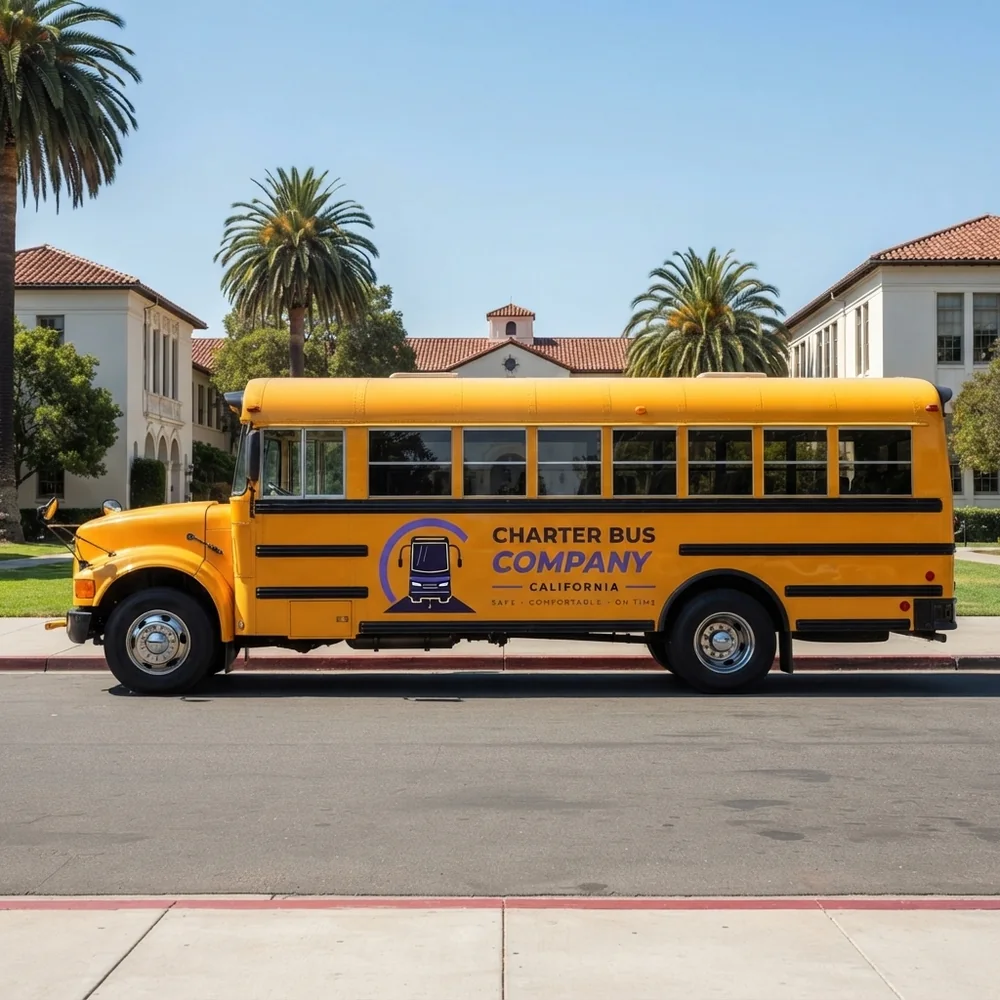
School Bus Rental
| Vehicle class | School bus |
|---|---|
| Passenger capacity | Based on student ages and adult count |
| Trip use | Local shuttles, School outings |
| Seating layout | Bench configuration by vehicle |
| Luggage storage | Confirm space for school supplies |
| Boarding access | Specify step-free boarding or lift requirements |
| Climate control | Confirm air conditioning on assigned vehicle |
| Onboard restroom | Confirm availability or plan stops |
| Wi-Fi | Request availability for travel dates |
| Charging ports | Specify USB or AC power needs |
| Audio and video | Specify microphone or screen needs |
| Seat belts | Confirm restraint type for the assigned seats |
| Driver service | With driver |
| Pricing | Private charter quote by itinerary |
| Service area | Orlando and Central Florida |
| Booking basis | Private group charter |
| Availability | Confirmed for requested travel dates |
Free Quote No payment needed now. We confirm price & availability first.
- Licensed & insured partner operators
- Professional, vetted drivers
- Clean, modern vehicles
- 24/7 booking support
Prefer to talk to a person?
Our California team replies fast, day or night.
School Bus Rental for Field Trips, Teams, Camps and Community Events
Few vehicles are as instantly recognizable, or as practical, as the yellow school bus. It is built around one job: moving a lot of people safely over short and medium distances, at a cost that school budgets can handle. Our school bus rental service gives you that same practicality with a professional driver, for a single field trip, a season of away games, a summer camp program or even a wedding with a sense of humor.
This page is organized around the questions principals, teachers, coaches, PTA volunteers and event planners ask us most. Jump to the one you need, or read straight through for the full picture.
Question 1: What exactly are we renting?
A full-size school bus with a professional driver. Our most popular vehicle is the 54-passenger school bus. Like most school buses, it is designed with bench seating, which explains the headline capacity number.
| Detail | What to expect |
|---|---|
| Capacity | Up to 54 passengers on bench seats (fewer if adults ride, as adults take more room per bench) |
| Seating | High-backed padded bench seats, designed to protect passengers |
| Storage | Limited. Small bags under seats or on laps. No under-floor luggage bays on most models |
| Climate | Heating standard. Air conditioning varies by vehicle, so ask if your trip is in summer or inland |
| Restroom | None |
| Driver | Professional, licensed driver included. [CONFIRM DRIVER CERTIFICATIONS, E.G. SPAB] |
| Rate | [PRICE OR “Custom quote by hours and mileage”] |
A note on capacity: “54 passengers” assumes three young children per bench. Teenagers and adults generally sit two per bench, which brings practical capacity closer to 36 to 40 people. When you request a quote, tell us the age mix and we will confirm whether one bus is enough. You can browse every school bus we offer in our school bus category.
Question 2: Is a school bus the right choice for our trip?
School buses are excellent for some trips and wrong for others. This quick test helps you decide.
Choose a school bus when
- The trip is local or regional, usually under about two hours each way.
- Your passengers are mostly children or teens.
- You are carrying little luggage: lunch bags, backpacks, small sports bags.
- Budget matters more than amenities.
- You want a vehicle that parents, staff and venues instantly recognize as a school group.
Choose a charter bus instead when
- The trip is long distance or overnight, and passengers need a restroom and reclining seats.
- The group has luggage, band instruments or bulky equipment.
- Passengers are mostly adults who expect individual seats.
- The weather will be hot and you cannot confirm air conditioning.
For longer or more comfortable trips, look at our 56-passenger charter bus or the 47-passenger charter bus. For smaller groups, a 25-passenger minibus may be more economical.
Question 3: Who rents school buses besides schools?
More groups than you might think. School buses are rugged, affordable and familiar, which makes them useful well beyond the classroom.
| Group | Typical trip |
|---|---|
| Public and private schools | Field trips, science centers, museums, outdoor education |
| Sports teams and athletic departments | Away games, tournaments, practice facilities |
| Summer camps and day camps | Daily camper pickups, excursions to beaches and parks |
| Churches and youth groups | Retreats, service projects, youth events |
| After-school and community programs | Regular weekly runs to activities |
| Colleges and universities | Orientation, volunteering days, intramural events |
| Wedding couples | Fun, retro guest shuttles between hotel, ceremony and reception |
| Film and TV productions | Crew shuttles and on-camera vehicles [CONFIRM IF YOU OFFER ON-CAMERA USE] |
| Corporate volunteer days | Moving staff to community projects |
Question 4: What does California require for school trips?
This is the most important question on this page, and the answer depends on who is riding and why.
In California, vehicles and drivers used to carry pupils to and from school activities are subject to specific rules. Depending on the vehicle and the trip, drivers may need special certificates, such as a School Pupil Activity Bus (SPAB) certificate, in addition to a commercial license. The California Department of Education’s special drivers certificate matrix explains which certificate applies to which type of trip, and the California DMV lists driver license certificates and endorsements.
The California Highway Patrol oversees inspection programs for school buses and pupil transportation vehicles. Charter-party carriers in California also generally need authority from the California Public Utilities Commission, explained on the CPUC charter-party carriers page.
What this means for you: if you are booking for a school or school district, check your district’s transportation policy and ask any operator to confirm in writing that the vehicle and driver meet the requirements for pupil transportation. We will provide:
- Our CPUC TCP number: [TCP NUMBER]
- Our USDOT number: [USDOT NUMBER]
- Driver certifications for your trip: [CONFIRM, E.G. “SPAB-certified drivers available for school activity trips”]
- Proof of insurance, with your school or district named as additional insured if required
Read more on our safety commitment page. For general school bus safety guidance for families, the National Highway Traffic Safety Administration publishes useful resources.
Question 5: How many buses do we need?
Start with the age of your passengers, because that sets the practical seats per bus.
| Passenger group | People per bench | Practical capacity of a 54-seat bus |
|---|---|---|
| Elementary students (K to 5) | 3 | About 54 |
| Middle school students | 2 to 3 | About 40 to 48 |
| High school students | 2 | About 36 |
| Adults | 2 | About 36 |
Worked example: a fourth-grade field trip with 92 students and 12 adult chaperones. The students fit about 3 per bench, so they need around 31 benches. The adults sit 2 per bench, so they need 6 more. That is 37 benches. A 54-passenger bus has about 18 benches, so the trip needs three buses, with chaperones spread across them. Two buses would be dangerously overcrowded.
Mixed group with lots of adults? Sometimes two buses plus a 14-passenger van for chaperones and supplies is cheaper than a third bus.
Question 6: What does a typical field trip day look like?
Here is an illustrative schedule for an elementary school trip to a science center about 45 minutes away.
- 8:15 am: Bus arrives at the school. The driver meets the lead teacher and confirms the headcount and route.
- 8:30 am: Students board class by class. Chaperones sit throughout the bus, not all at the front.
- 8:40 am: Departure, after a final headcount.
- 9:30 am: Arrival at the venue’s bus drop-off zone. Students exit with their chaperone groups.
- 9:30 am to 1:30 pm: The driver either waits on site or leaves and returns, depending on the booking.
- 1:30 pm: Headcount at the bus. Nobody boards until their group is complete.
- 1:45 pm: Departure for school, with a second headcount on board.
- 2:35 pm: Arrival in time for regular dismissal.
Venues usually have specific bus drop-off areas. Check with the venue when you book your visit, and pass that information to us.
Question 7: Where do California schools go on field trips?
California has an extraordinary range of educational destinations, and most of them are well within school bus range of a major city. These are some of the trips we see booked most often. Always check the venue’s own group booking rules, bus parking instructions and accessibility information before you confirm transport.
Science and technology
Science centers are year-round favorites because they work in any weather. Popular choices include the California Science Center in Los Angeles, home to the Space Shuttle Endeavour, and the Exploratorium on the San Francisco waterfront. Both have dedicated programs for school groups.
History and government
Fourth graders across California study state history, which makes the California missions, Gold Rush sites and the State Capitol in Sacramento classic destinations. The California State Capitol Museum offers tours for school groups.
Marine science and the coast
Aquariums, tide pools and marine centers bring science lessons to life. The Monterey Bay Aquarium is one of the best known, and coastal state parks offer ranger-led programs. Remember that coastal trips can involve long drive times, so plan for an early start.
Outdoor education and camps
Many California districts send students to multi-day outdoor science schools in the mountains. These trips combine students, staff and luggage, which may need a mix of school buses for passengers and a separate vehicle for bags. Mountain roads can have winter weather, so we watch conditions before departure.
Arts and performance
Theater matinees, museum visits and music festivals are popular with middle and high schools. Downtown venues may have strict bus loading times, so share them with us in advance.
Question 8: How do you keep students safe on board?
Safety on a school trip is shared between the operator, the driver and the school staff. Here is how each part works.
Our part
- Professional drivers with the licensing and certificates required for your trip. [CONFIRM DETAILS.]
- Pre-trip vehicle inspections by the driver before every departure.
- Regular maintenance and inspections. [DESCRIBE YOUR MAINTENANCE PROGRAM.]
- Dispatch support throughout the trip at +1 (308) 304-6668.
Your part
- Enough adult chaperones to supervise students on board and at the venue.
- A clear headcount routine at every boarding.
- Accurate passenger lists with emergency contacts and medical information.
- Reinforcing bus behavior rules with students before departure.
Emergency exits
Before departure, the driver can point out the emergency exits, including the rear door, roof hatches and emergency windows, to chaperones. Ask for a quick walkthrough if your chaperones are not regular school bus riders.
Question 9: Can students who use wheelchairs travel with the group?
Yes, and every student should be able to travel with their class. If any student uses a wheelchair or mobility device, tell us at the quote stage. Depending on availability, we can provide a lift-equipped vehicle, such as our wheelchair accessible shuttle bus, traveling on the same schedule as the main buses, so the student arrives and leaves with their classmates. The ADA.gov site has more on accessible transportation.
Question 10: What should teachers and coaches do on the day?
Before you leave
- Bring a printed passenger list for each bus, with emergency contacts.
- Assign each chaperone a group and a seat area.
- Review simple bus rules with students: stay seated, keep the aisle clear, hands and heads inside, voices low enough for the driver to concentrate.
- Carry any student medications and medical information with the group.
During the trip
- Count heads every time students board.
- Keep the front seats clear so the driver has a clear view and students cannot distract them.
- Let the driver know immediately if a student feels unwell.
After the trip
- Do a final walk through the bus to collect lost lunch bags, jackets and water bottles.
- Report any issues to us so we can address them before the next trip.
Question 11: Can we book a bus for a whole season?
Yes. Athletic departments, after-school programs and camps often need the same trip repeatedly. [DESCRIBE YOUR RECURRING OR CONTRACT OPTIONS, E.G. “We offer season schedules for sports teams and weekly runs for camps and community programs, with consistent drivers where possible.”]
For a season schedule, send us:
- Every date and destination on your calendar
- Departure and expected return times
- Expected headcount for each trip, including coaches and equipment
- Any trips that might move because of playoffs or weather
Question 12: Why would anyone book a school bus for a wedding?
Because it is fun, it photographs brilliantly, and it moves a lot of guests at a sensible cost. Retro school bus shuttles have become a favorite for rustic, barn, vineyard and summer camp-style weddings across California. Guests pile on at the hotel, the ride itself becomes part of the celebration, and nobody has to drive home.
If you want something with a little more polish, consider a charter trolley rental. For a more comfortable ride on longer transfers, see our shuttle bus rental.
Question 13: What affects the price?
- Hours of service, including the bus’s travel to your first pickup. Most bookings have a minimum. [ADD MINIMUM HOURS.]
- Mileage, for trips outside the local area.
- Number of buses. Multiple buses on the same trip are coordinated by our dispatch team.
- Day and time. School-day mornings and afternoons are in high demand because they overlap with regular school routes.
- Waiting time. If the driver stays on site, that time is billed. If the venue is close, releasing the bus and booking a return may save money.
- Parking and venue fees, where they apply. [STATE GRATUITY POLICY.]
Public schools and districts often need specific paperwork before a booking can be approved. [DESCRIBE IF YOU ACCEPT PURCHASE ORDERS OR OFFER INVOICING FOR SCHOOLS.]
Question 14: How far in advance should we book?
Field trip season peaks in spring, when many schools schedule end-of-year trips at the same time. Sports seasons also concentrate demand on the same afternoons. Our advice:
- Spring field trips (March to June): book as soon as your venue date is confirmed, ideally six to eight weeks ahead.
- Sports seasons: send the full schedule at the start of the season.
- Summer camps: book in spring for June to August programs.
- Weekend events and weddings: two to three months ahead is comfortable.
Question 15: What if our plans change?
Schools close for weather, games get rescheduled and headcounts change. Tell us as early as possible. Our refund and cancellation policy explains the deadlines and any fees, and our terms and conditions cover changes to bookings.
Question 16: How do summer camp and program runs work?
Day camps and summer programs often need the same route every weekday for several weeks: morning pickups at one or more meeting points, a drop at the camp site, and an afternoon return. Some also add weekly excursions to beaches, pools, parks or museums.
- Fixed meeting points work better than door-to-door pickups for large groups. A school parking lot or community center makes a safe, easy stop.
- Consistent timing helps parents. We plan the route so the bus arrives at the same time each day.
- Sign-in and sign-out sheets at each stop keep counselors and parents confident about who is on board.
- Hot-weather planning matters for summer. Ask us to confirm air conditioning, and keep water on board.
- Excursion days can be added to the same booking so you work with one transport provider all summer.
Question 17: What should we ask any school bus company before booking?
Whether you book with us or someone else, these questions protect your students and your school.
- Are you authorized by the CPUC, and what is your TCP number?
- What certificates do your drivers hold for pupil transportation?
- How are drivers screened, trained and tested?
- When were the buses last inspected?
- Can you provide a certificate of insurance naming our school or district?
- Do the buses have air conditioning and seat belts?
- What happens if a bus breaks down during the trip?
- What are your cancellation terms for weather closures?
You can check any carrier that crosses state lines on FMCSA SAFER.
Other Vehicles for School and Youth Groups
- Full-size charter bus rental in Orlando for school trips to Central Florida theme parks.
- 40-passenger charter bus for band, choir and debate trips with luggage.
- Wheelchair accessible shuttle bus for students who use wheelchairs.
- Minibus rentals for clubs and small teams.
- Double-decker bus rental for graduation celebrations and campus events.
School Bus Rental FAQ
Do your school buses have seat belts?
[CONFIRM FOR YOUR FLEET.] Many school buses use compartmentalization, with high, padded seat backs, as their main protection. Some newer buses also have lap-shoulder belts.
Do your school buses have air conditioning?
[CONFIRM FOR YOUR FLEET.] Air conditioning varies by bus. If your trip is in summer or to a hot inland area, ask us to confirm.
Can parents ride the bus?
Yes, as chaperones, as long as total passengers do not exceed the bus’s safe capacity. Remember adults usually sit two per bench.
Can we eat on the bus?
[STATE YOUR POLICY.] Many groups allow water only, with lunch at the venue, to keep the bus clean and reduce allergy risks.
Can a school bus go on the freeway and out of town?
Yes. School buses are fine for regional trips. For long trips, a charter bus with reclining seats and a restroom is more comfortable.
Can the driver wait at the venue all day?
Yes. On hourly bookings the driver can stay on site, usually in the venue’s bus parking area. For long visits close to school, it may be cheaper to release the bus and book a separate return trip.
How many chaperones should we bring?
Follow your school or district policy. As a general guide, many schools aim for at least one adult per 10 younger students, with at least one adult seated near the back of every bus.
Can we bring sports equipment on a school bus?
Small bags fit under seats or on spare benches. Large equipment such as bats, bags of balls or instruments may need a spare bench, a second vehicle, or a charter bus with storage bays.
Do you rent school buses without a driver?
No. Every rental includes a professional driver.
Can we decorate the bus for a wedding or team spirit?
Removable decorations that do not damage the bus or block windows and exits are usually fine. Ask us first.
Do you serve schools outside California?
[CONFIRM YOUR SERVICE AREA.] For Florida school trips, see our minibus rental in Orlando and full-size coach options.
Book Your School Bus
Not sure yet how many buses you need, or whether a school bus or a charter coach suits your trip better? That is exactly what our team is here for. Share what you know, even if the details are still rough, and we will help you plan the rest.
Send us your date, destination, headcount and age mix, and we will confirm the number of buses, driver requirements and a written quote. Request a school bus quote, call +1 (308) 304-6668, or reach us through our contact page. You can also explore our full fleet of vehicles.
Reviews
There are no reviews yet.